state capitals list
Have you ever wondered why certain cities become capitals while much larger and more famous cities do not? The United States is home to 50 states, and each state has its own capital city that serves as the center of government and administration. While many people can easily name capitals like Austin or Denver, remembering the complete state capitals list can be challenging. Understanding these capitals is important for students, travelers, history enthusiasts, and anyone interested in American geography.
State capitals are much more than locations on a map. They are home to state legislatures, governors’ offices, supreme courts, and many important government institutions. Some capitals are among the oldest cities in America, while others were specifically chosen to support population growth and regional development. This comprehensive guide explores the complete state capitals list, their history, significance, and the role they play in modern governance.
Understanding the State Capitals List
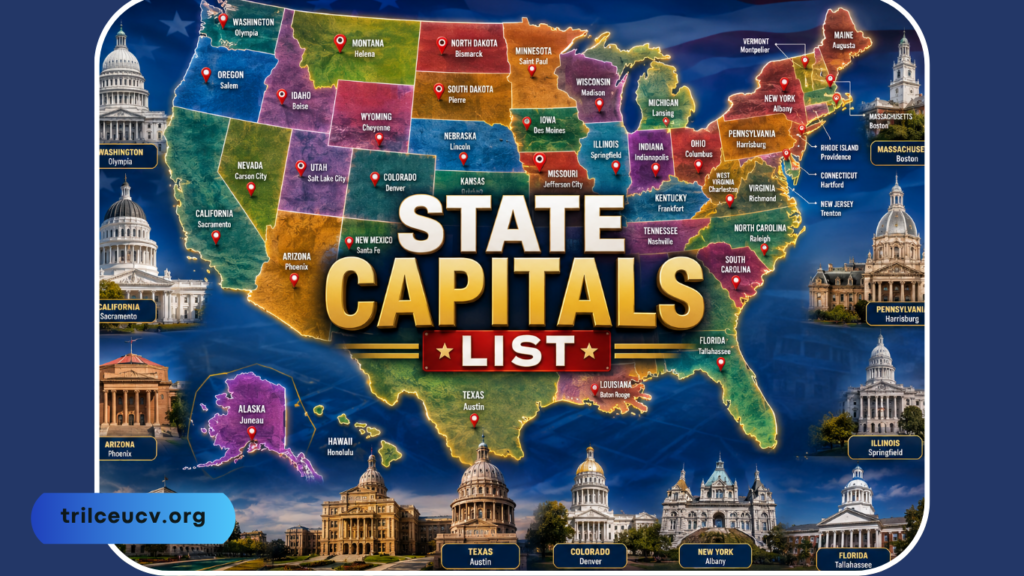
The state capitals list includes one capital city for each of the 50 U.S. states. These cities function as the official seats of state government and are responsible for hosting legislative sessions, executive offices, and judicial institutions. Every state chooses a capital to serve as its political and administrative center.
Interestingly, the largest city in a state is often not its capital. For example, New York City is much larger than Albany, and Los Angeles is significantly larger than Sacramento. This distinction exists because capitals were often selected based on geographic accessibility, historical importance, or political considerations rather than population size.
The state capitals list is a fundamental topic in American geography and civics education. Students frequently learn these capitals in school because they provide a deeper understanding of how state governments function. Knowledge of capitals also helps people better understand regional culture, history, and political systems across the country.
Complete State Capitals List by State
The following table provides a complete state capitals list for all 50 states.
| State | Capital City |
|---|---|
| Alabama | Montgomery |
| Alaska | Juneau |
| Arizona | Phoenix |
| Arkansas | Little Rock |
| California | Sacramento |
| Colorado | Denver |
| Connecticut | Hartford |
| Delaware | Dover |
| Florida | Tallahassee |
| Georgia | Atlanta |
| Hawaii | Honolulu |
| Idaho | Boise |
| Illinois | Springfield |
| Indiana | Indianapolis |
| Iowa | Des Moines |
| Kansas | Topeka |
| Kentucky | Frankfort |
| Louisiana | Baton Rouge |
| Maine | Augusta |
| Maryland | Annapolis |
| Massachusetts | Boston |
| Michigan | Lansing |
| Minnesota | Saint Paul |
| Mississippi | Jackson |
| Missouri | Jefferson City |
These capitals represent the first half of the nation’s state government centers. Each city has unique historical significance and plays a vital role in state administration.
Many of these capitals were selected because of their strategic location within the state. Others gained prominence due to economic development, transportation networks, or historical events that shaped state boundaries and governance.
Remaining U.S. State Capitals
The second half of the state capitals list completes the full set of 50 state capitals.
| State | Capital City |
|---|---|
| Montana | Helena |
| Nebraska | Lincoln |
| Nevada | Carson City |
| New Hampshire | Concord |
| New Jersey | Trenton |
| New Mexico | Santa Fe |
| New York | Albany |
| North Carolina | Raleigh |
| North Dakota | Bismarck |
| Ohio | Columbus |
| Oklahoma | Oklahoma City |
| Oregon | Salem |
| Pennsylvania | Harrisburg |
| Rhode Island | Providence |
| South Carolina | Columbia |
| South Dakota | Pierre |
| Tennessee | Nashville |
| Texas | Austin |
| Utah | Salt Lake City |
| Vermont | Montpelier |
| Virginia | Richmond |
| Washington | Olympia |
| West Virginia | Charleston |
| Wisconsin | Madison |
| Wyoming | Cheyenne |
Together, these cities form the complete state capitals list used throughout educational curricula, government documentation, and geographic references.
Several capitals such as Santa Fe and Richmond are known for their rich historical heritage, while others like Austin and Columbus have experienced rapid modern growth. Despite differences in size and culture, all capitals share the common responsibility of serving as centers of state government.
Why States Have Capital Cities
State capitals exist to centralize government operations and provide a location where elected officials can conduct legislative business. Without a designated capital, government functions would be scattered across multiple cities, making administration less efficient.
Historically, many capitals were selected because they were located near the geographic center of a state. This made travel easier for representatives during times when transportation was limited. As populations shifted over time, some capitals remained unchanged despite major demographic changes.
The capital city serves as the home of state government agencies, archives, public records offices, and legislative chambers. These institutions help ensure that laws are created, interpreted, and enforced efficiently across the state. The state capital also often symbolizes political identity and historical continuity.
The Difference Between a Capital and the Largest City
One common misconception is that every state capital is also the state’s largest city. In reality, many capitals are smaller than other cities within the same state. This difference often surprises people studying the state capitals list for the first time.
For example, Sacramento serves as California’s capital even though Los Angeles and San Diego have much larger populations. Similarly, Albany is New York’s capital despite New York City’s enormous size and influence. These choices reflect historical decisions rather than population rankings.
Capitals are selected based on administrative convenience, political compromise, and historical context. While large cities often dominate commerce and culture, capitals focus primarily on governance and public administration. This distinction helps explain why many capitals remain relatively modest in size compared to major metropolitan areas.
Historical Development of State Capitals
The history of state capitals reflects the broader history of the United States. Some capitals have served continuously since colonial times, while others changed locations multiple times before settling into their current role.
In the early years of statehood, capitals were often moved to accommodate population growth and territorial expansion. As settlers moved westward, governments sought more central locations to better serve residents. This process resulted in several capital relocations throughout American history.
Many current capitals preserve historic buildings, monuments, and government facilities dating back centuries. These landmarks provide insight into political development, architectural styles, and civic traditions. Understanding the evolution of state capitals helps explain how states adapted to changing economic and demographic conditions.
The Smallest State Capitals by Population
Some of the cities on the state capitals list are surprisingly small. These capitals demonstrate that population size is not a requirement for serving as a governmental center.
Among the smallest state capitals are Montpelier, Vermont; Pierre, South Dakota; and Augusta, Maine. Despite their limited populations, these cities successfully host state legislatures, courts, and executive offices. Their small size often contributes to a close-knit political environment.
Smaller capitals may lack the extensive infrastructure of larger cities, but they often benefit from lower costs, reduced congestion, and strong historical identity. These characteristics make them unique among American government centers.
The Largest State Capitals in America
At the opposite end of the spectrum are capitals with substantial populations and thriving economies. Cities such as Phoenix, Austin, Columbus, and Indianapolis have grown into major urban centers while retaining their governmental functions.
Rapid economic development, technology industries, educational institutions, and population growth have contributed to the expansion of these capitals. Many now rank among the fastest-growing cities in the United States.
Large capitals often balance government operations with business, tourism, higher education, and cultural attractions. Their diverse economies make them important regional hubs that extend far beyond political administration.
State Capitols and Government Buildings
A state capitol building is one of the most recognizable landmarks in a capital city. These structures house legislative chambers and often feature distinctive architectural styles.
Many capitol buildings include domes, grand staircases, historic artwork, and public monuments. They serve not only as workplaces for elected officials but also as symbols of democracy and civic participation. Visitors frequently tour capitol buildings to learn about state history and government processes.
The design of capitol buildings reflects the values and aspirations of their states. Architectural influences range from classical Greek and Roman styles to modern interpretations of public architecture. These buildings remain important cultural and historical assets.
State Capitals and Tourism
State capitals attract millions of visitors each year. Travelers often visit capitals to explore museums, historic districts, government landmarks, and cultural attractions.
Popular destinations include Austin’s live music scene, Denver’s outdoor recreation opportunities, Boston’s historical significance, and Honolulu’s unique island culture. Many capitals combine government functions with vibrant tourism industries.
Tourism contributes significantly to local economies by supporting hotels, restaurants, transportation services, and entertainment venues. As a result, many capitals invest heavily in preserving historic sites and promoting cultural experiences.
Learning the State Capitals List Easily
Students often look for effective methods to memorize the state capitals list. Fortunately, several learning techniques can make the process easier and more enjoyable.
Helpful strategies include:
- Using flashcards
- Practicing map quizzes
- Grouping states by region
- Creating memory associations
- Using educational games
- Reviewing regularly
These techniques improve retention and help learners develop a stronger understanding of U.S. geography. Consistent practice is usually more effective than attempting to memorize all capitals at once.
Regional Organization of State Capitals
One useful way to study capitals is by dividing them into geographic regions. Regional learning simplifies memorization and highlights relationships between neighboring states.
For example, the Northeast includes capitals such as Albany, Boston, Concord, and Providence. The South contains capitals like Atlanta, Raleigh, and Tallahassee. Western capitals include Boise, Helena, Olympia, and Sacramento.
Regional organization also helps travelers and geography enthusiasts understand broader patterns of settlement, economic development, and political history throughout the country.
State Capitals and Education
The state capitals list remains a core component of geography and civics education in American schools. Students learn capitals to strengthen map-reading skills and develop a better understanding of governmental structures.
Educational programs often integrate capitals into lessons about history, government, economics, and culture. Learning capitals encourages students to explore the diversity of states and regions across the nation.
Knowledge of state capitals supports broader civic literacy by helping citizens understand where legislative decisions are made and how state governments operate.
Interesting Facts About U.S. State Capitals
Many state capitals have unique characteristics that make them memorable. Some are among the oldest continuously inhabited cities in North America, while others were purpose-built for government functions.
Here are a few interesting facts:
- Juneau is accessible primarily by air or water.
- Santa Fe is the oldest state capital in the United States.
- Phoenix is one of the largest state capitals by population.
- Montpelier is the least populous state capital.
- Austin is known as the “Live Music Capital of the World.”
These facts add depth and context to the state capitals list, making it more engaging for students and travelers alike.
Why State Capitals Matter Today
Even in an era of digital communication and remote work, state capitals remain essential to government operations. Legislative sessions, judicial proceedings, public meetings, and administrative functions continue to take place within these cities.
Capitals serve as centers of policy development, public service delivery, and democratic participation. They provide a physical location where citizens can engage with elected representatives and government agencies.
As states continue to evolve, their capitals remain symbols of governance, history, and civic identity. Understanding the state capitals list helps people appreciate the structure and function of state government throughout the United States.
Conclusion
The complete state capitals list represents far more than a collection of city names. These 50 capitals serve as the political and administrative centers of their respective states, housing legislatures, governors’ offices, courts, and government agencies. From historic cities like Santa Fe and Richmond to rapidly growing capitals such as Austin and Phoenix, each capital contributes to the unique identity of its state.
Whether you are studying geography, preparing for a quiz, planning travel, or simply expanding your knowledge, understanding the state capitals list provides valuable insight into American history, government, and regional development. These cities continue to play a critical role in shaping policy, preserving heritage, and supporting democratic institutions across the nation.
Frequently Asked Questions
What is a state capital?
A state capital is the official city where a state’s government is headquartered and where legislative, executive, and judicial functions are conducted.
How many state capitals are there in the United States?
There are 50 state capitals, one for each U.S. state.
Is the largest city always the state capital?
No. Many states have capitals that are smaller than their largest cities. Examples include Albany in New York and Sacramento in California.
What is the oldest state capital?
Santa Fe, New Mexico, is considered the oldest state capital in the United States.
What is the smallest state capital by population?
Montpelier, Vermont, is the least populous state capital.
Why do students learn the state capitals list?
Students learn state capitals to improve geography knowledge, map-reading skills, and understanding of state government structures.
Which state capital has the largest population?
Phoenix, Arizona, is generally recognized as the most populous state capital in the United States.
Can a state change its capital city?
Yes. Several states have changed their capitals throughout history, although such changes are relatively uncommon today.