what does stg mean when texting
Have you ever received a text saying “STG” and wondered what it actually means? You are not alone. Internet slang changes fast, and abbreviations like STG are now common across texting apps, social media platforms, gaming chats, and online conversations. Whether you are chatting on Snapchat, Instagram, TikTok, WhatsApp, or Discord, understanding modern texting slang helps you communicate better and avoid confusion.
The term “STG” is especially popular among teenagers and young adults because it adds emotion, seriousness, and emphasis to a message. Depending on the context, it can make someone sound frustrated, honest, emotional, or completely serious about what they are saying. Since texting language evolves rapidly, many people search for the exact meaning of STG, how it is used, and when it is appropriate to use it in conversations.
In this complete guide, you will learn everything about what STG means when texting, where it came from, how people use it online, examples in conversations, alternative meanings, social media usage, slang comparisons, and much more. By the end of this article, you will fully understand STG and confidently use it in your own chats.
What Does STG Mean in Texting?
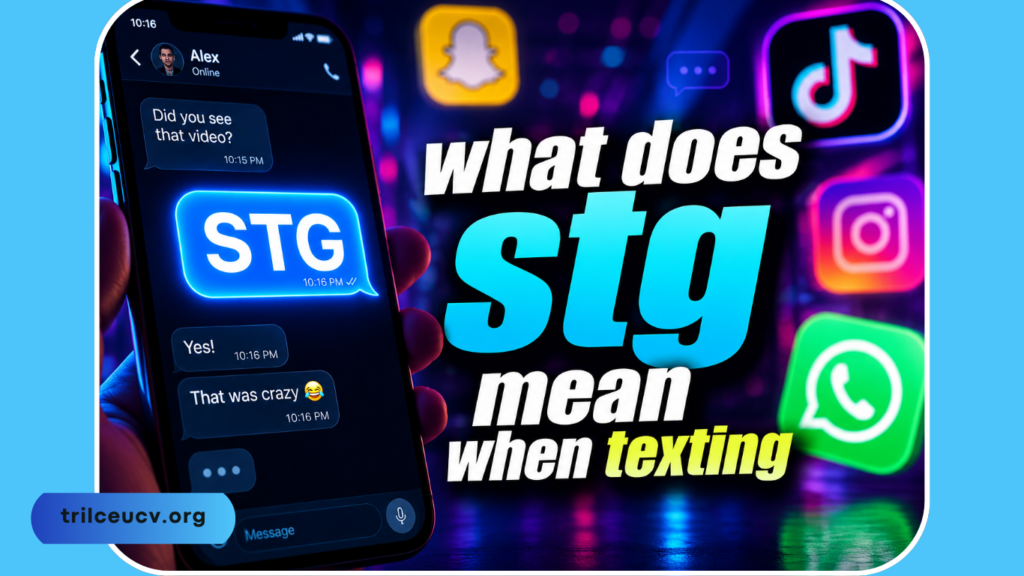
STG usually stands for “Swear To God” in texting and online conversations. It is used when someone wants to show they are being completely honest or serious about something. People often use it to add emphasis to a statement or convince someone they are telling the truth.
For example, if someone says, “STG I didn’t touch your phone,” they are strongly insisting they are innocent. The abbreviation carries emotional weight and is commonly used during serious, funny, dramatic, or emotional conversations.
The phrase “Swear To God” itself has existed for decades in spoken language, but the shortened version “STG” became popular with the rise of mobile texting, social media apps, and internet culture. Abbreviations save time while typing and make casual communication faster.
Here are some quick examples of STG in text messages:
| Text Message | Meaning |
|---|---|
| “STG this movie is amazing” | The person strongly believes the movie is great |
| “I’m tired STG” | The person is extremely tired |
| “STG I saw him there” | The person is insisting they are telling the truth |
Today, STG is widely recognized across online communities and digital conversations.
Origin and History of STG
The abbreviation STG emerged from internet shorthand culture during the early growth of texting and instant messaging. As character limits became common on phones and social media platforms, people started shortening longer phrases into acronyms.
“Swear To God” was already a popular phrase in spoken English before texting existed. People traditionally used it to promise honesty or emphasize seriousness. Once online communication exploded through SMS messaging, chatrooms, and social apps, users shortened the phrase into STG for convenience.
During the late 2000s and early 2010s, slang abbreviations like LOL, BRB, OMG, and STG became part of everyday online communication. Younger generations especially adopted these terms because they allowed quick emotional expression without long sentences.
Social media platforms accelerated the popularity of STG. Apps like Snapchat, TikTok, Instagram, Twitter, and Discord made short-form communication normal. As memes and viral trends spread, abbreviations became deeply integrated into internet culture.
Today, STG is recognized globally among English-speaking internet users. Even though slang changes over time, STG remains common because it clearly communicates seriousness and emotional intensity in a short form.
How STG Is Used in Conversations
People use STG in many different ways depending on the tone and context of the conversation. Sometimes it expresses honesty, while other times it adds humor, exaggeration, or frustration.
In casual chats, STG is often used to convince someone that a statement is true. For example:
- “STG I completed the assignment already.”
- “STG I didn’t hear my alarm.”
In emotional situations, the abbreviation can emphasize strong feelings. Someone might say:
- “STG this is the best food I’ve ever eaten.”
- “I’m so tired STG.”
The abbreviation is also common during arguments or defensive conversations. If someone feels accused unfairly, they may use STG to strengthen their denial or explanation.
Another important aspect is tone. In some situations, STG sounds serious, while in others it is playful or dramatic. Context determines how people interpret it.
For example:
| Sentence | Tone |
|---|---|
| “STG I forgot” | Defensive |
| “This song is fire STG” | Excited |
| “STG stop annoying me” | Frustrated |
| “I’m crying STG” | Emotional or dramatic |
Because of its flexibility, STG works in many types of conversations online.
STG Meaning on Snapchat
Snapchat users frequently use STG in chats, stories, and private messages. Since Snapchat focuses on fast and casual communication, abbreviations are extremely popular there.
On Snapchat, STG usually still means “Swear To God.” People use it while reacting to photos, sharing emotional moments, or emphasizing something funny or dramatic.
For example:
- “STG this filter makes me look weird.”
- “I saw your crush today STG.”
- “STG I almost dropped my phone.”
Snapchat conversations tend to be informal and spontaneous. Because messages disappear quickly, users often type shorthand slang instead of full sentences.
Teenagers and younger users especially use STG frequently on Snapchat because the app encourages relaxed communication styles. It helps express authenticity, honesty, and strong emotions quickly.
Sometimes STG is also used jokingly. Friends may exaggerate stories or reactions using the abbreviation for comedic effect. Understanding the tone of the conversation is important when interpreting its meaning.
Overall, Snapchat helped make abbreviations like STG even more mainstream in digital communication.
STG Meaning on TikTok and Instagram
TikTok and Instagram have their own internet language culture, and STG is widely used across comments, captions, direct messages, and memes.
On TikTok, creators often use STG to exaggerate reactions or emphasize emotions in relatable videos. You might see captions like:
- “STG this happens every morning.”
- “This song is stuck in my head STG.”
TikTok humor often relies on dramatic storytelling and relatable experiences, which makes STG a perfect fit for the platform’s style.
Instagram users also use STG in reels, captions, and comments. It adds emotional emphasis while keeping text short and trendy. Since social media rewards quick engagement, abbreviations help users communicate faster.
Influencers and meme accounts frequently use slang like STG because it feels conversational and relatable to younger audiences. The abbreviation has become part of internet culture rather than just texting slang.
Many people who are unfamiliar with online abbreviations first encounter STG on social media platforms, leading them to search for its meaning afterward.
Different Meanings of STG Besides “Swear To God”
Although “Swear To God” is the most common meaning, STG can sometimes stand for other phrases depending on the context.
Here are a few alternative meanings:
| STG Meaning | Context |
|---|---|
| Swear To God | Texting and slang |
| Setting | Gaming or technology |
| Sterling | Finance or currency |
| Shoot The Gap | Gaming slang |
However, in everyday texting and social media conversations, “Swear To God” is overwhelmingly the most popular interpretation.
Context matters when interpreting abbreviations. For example, in gaming forums, STG might refer to settings or gameplay terminology. In finance discussions, it could relate to British sterling currency.
Still, if you see STG in a casual chat, DM, or social media comment, it almost always means “Swear To God.”
Understanding the context of the conversation helps avoid confusion and ensures accurate interpretation.
Why People Use STG in Text Messages
There are several reasons why STG became so popular in texting culture. One major reason is efficiency. Typing “STG” is much faster than typing “Swear To God.”
Another reason is emotional emphasis. The abbreviation instantly adds seriousness or intensity to a statement without needing a long explanation.
People also use STG because it feels natural in modern internet communication. Short abbreviations have become a huge part of online culture, especially among younger generations.
Common reasons people use STG include:
- To emphasize honesty
- To sound emotional or dramatic
- To react strongly to something
- To type faster
- To fit into internet slang culture
Texting slang often evolves because users want communication to feel quick, expressive, and relatable. STG perfectly fits that purpose.
Additionally, abbreviations create a sense of community among internet users. Understanding slang terms helps people feel connected to online trends and digital culture.
Is STG Considered Rude or Offensive?
In most situations, STG is not considered offensive. However, its appropriateness depends on the audience and conversation.
Because STG stands for “Swear To God,” some religious individuals may feel uncomfortable with the phrase. In certain cultures or families, using God’s name casually can be viewed as disrespectful.
Among friends and online communities, though, STG is usually seen as harmless slang. Most people use it casually without intending offense.
Professional settings are different. Using STG in workplace emails, academic writing, or formal communication is generally inappropriate because it sounds too casual and slang-heavy.
Here is a quick breakdown:
| Situation | Appropriate? |
|---|---|
| Friends texting | Yes |
| Social media comments | Yes |
| Workplace emails | No |
| School essays | No |
| Casual group chats | Yes |
Understanding your audience is important before using internet slang terms like STG.
Examples of STG in Real Text Conversations
Seeing STG used naturally helps make its meaning clearer. Here are realistic examples of how people use the abbreviation in daily texting.
Friendly Conversation
Person A: “Did you really meet him?”
Person B: “STG I did.”
Funny Conversation
Person A: “You eat pizza every day.”
Person B: “STG I can’t stop.”
Emotional Conversation
Person A: “Are you okay?”
Person B: “No STG I’m exhausted.”
Dramatic Reaction
Person A: “That movie ending was crazy.”
Person B: “STG I almost cried.”
These examples show how flexible the abbreviation can be. It works in serious, emotional, funny, and exaggerated contexts.
The tone often depends on punctuation, emojis, and the surrounding conversation. Online slang is highly contextual, so understanding emotional cues matters.
Popular Slang Terms Related to STG
STG belongs to a larger family of internet slang and texting abbreviations. Many users who search for STG also want to understand related slang terms.
Here are some popular abbreviations commonly used alongside STG:
- OMG — Oh My God
- TBH — To Be Honest
- IMO — In My Opinion
- NGL — Not Gonna Lie
- FR — For Real
- ISTG — I Swear To God
- SMH — Shaking My Head
Among these, ISTG is especially similar to STG. Both expressions emphasize seriousness or honesty.
For example:
- “ISTG I forgot.”
- “STG I forgot.”
The meanings are almost identical, though ISTG explicitly includes “I.”
Learning related slang terms helps improve understanding of internet communication and modern texting culture.
Difference Between STG and ISTG
Many people confuse STG and ISTG because they are closely related abbreviations. However, there is a slight difference.
| Abbreviation | Full Form | Meaning |
|---|---|---|
| STG | Swear To God | General emphasis |
| ISTG | I Swear To God | Personal emphasis |
ISTG sounds slightly more direct because it explicitly starts with “I.” Meanwhile, STG feels shorter and more casual.
Examples:
- “ISTG I’m telling the truth.”
- “STG this happened yesterday.”
Both are common on social media and texting apps. The choice usually depends on personal typing habits and conversational style.
Some users prefer ISTG because it sounds clearer, while others prefer STG because it is shorter.
How Teenagers Use STG Today
Teenagers are among the biggest users of internet slang, including STG. Modern digital communication heavily relies on abbreviations because younger users value fast, expressive conversations.
Teenagers often use STG dramatically or humorously rather than literally. For example:
- “STG school is ruining my sleep.”
- “This game is impossible STG.”
In many cases, the phrase is exaggerated for comedic effect. Social media humor frequently depends on emotional exaggeration and relatable struggles.
Teenagers also adapt slang rapidly. Terms can trend for months and then disappear quickly. However, STG has remained popular because it is simple, expressive, and easy to understand.
Online gaming communities, TikTok trends, and meme culture continue influencing how young people use abbreviations like STG.
Parents and older users sometimes struggle to understand modern slang, which is why guides explaining texting abbreviations have become increasingly popular online.
STG in Gaming and Online Communities
Gaming culture has significantly contributed to the spread of abbreviations like STG. Fast-paced multiplayer games encourage quick communication, making shorthand language extremely useful.
Gamers use STG during voice chats, text chats, and livestream comments. For example:
- “STG this lag is terrible.”
- “I hit that shot STG.”
Gaming communities often combine humor, frustration, and emotional reactions, making STG fit naturally into conversations.
Platforms like Discord, Twitch, and online multiplayer games helped normalize abbreviations even more. Users type quickly while reacting in real time, so shorter phrases are preferred.
Online communities beyond gaming also use STG frequently. Meme pages, Reddit discussions, fan communities, and livestream chats all contribute to internet slang evolution.
The widespread use of STG across multiple platforms shows how deeply embedded texting slang has become in digital culture.
Should You Use STG in Professional Communication?
Generally, STG should be avoided in professional settings. Although it is acceptable in casual conversations, it appears too informal for business or academic communication.
Using slang in professional environments can make messages seem unprofessional or unclear. Workplace emails usually require formal language and proper grammar.
Instead of using STG professionally, clearer alternatives include:
- “I assure you”
- “Honestly”
- “I promise”
- “I am serious”
Professional communication values clarity and professionalism over internet slang.
However, in casual workplace chats among close coworkers, some people may still use abbreviations informally. It depends on company culture and communication style.
As a general rule, save STG for friends, social media, gaming chats, and informal texting rather than formal situations.
How Internet Slang Changes Language
Internet slang like STG has changed modern communication dramatically. Language evolves constantly, and digital platforms accelerate those changes faster than ever before.
Abbreviations simplify communication while adding emotional tone and personality. Younger generations especially shape how slang spreads through social media trends and viral content.
Some slang disappears quickly, while other terms become permanent parts of internet culture. STG has remained popular because it fulfills a practical purpose: expressing seriousness quickly.
Critics sometimes argue that slang harms grammar skills, but others believe it reflects creativity and natural language evolution. In reality, most people easily switch between formal and informal communication styles.
Internet slang also creates shared cultural understanding. Knowing abbreviations like STG helps users feel connected to online communities and modern digital conversations.
As technology continues evolving, new slang terms will continue appearing across apps, games, and social platforms.
Common Misunderstandings About STG
Because abbreviations can have multiple meanings, misunderstandings sometimes happen. Some people think STG is offensive, while others confuse it with unrelated acronyms.
A common misunderstanding is assuming STG always has a religious meaning. In reality, most users simply treat it as casual internet slang rather than a deeply religious statement.
Another misconception is that STG is only used by teenagers. While younger users popularized it, many adults also use the abbreviation online.
Some people also mistake STG for technical or gaming terminology when seeing it outside texting contexts. Again, context usually reveals the intended meaning.
Understanding slang requires paying attention to:
- Tone
- Platform
- Conversation topic
- Audience
Once you understand these factors, interpreting abbreviations like STG becomes much easier.
The Future of Texting Abbreviations Like STG
Texting slang will likely continue evolving as technology changes. New apps, trends, memes, and communication styles constantly influence how people interact online.
Despite changing trends, abbreviations like STG remain popular because they are simple, expressive, and widely recognized. They efficiently communicate emotion and seriousness in digital conversations.
Voice messaging and AI communication tools may eventually reduce heavy abbreviation use, but slang itself will probably never disappear. Humans naturally create shortcuts and expressive language styles.
Future generations may invent completely new abbreviations, but many current slang terms will remain part of internet history and online culture.
Understanding texting slang is increasingly important because digital communication dominates everyday life. Whether chatting with friends, using social media, or participating in online communities, slang literacy improves communication and social understanding.
Conclusion
STG most commonly means “Swear To God” in texting, social media, gaming chats, and online conversations. People use it to emphasize honesty, seriousness, emotion, or dramatic reactions. The abbreviation became popular through texting culture and remains widely used across platforms like Snapchat, TikTok, Instagram, Discord, and WhatsApp.
Although STG is generally harmless in casual communication, it should usually be avoided in professional settings. Understanding context is important because tone determines whether the abbreviation sounds serious, funny, emotional, or exaggerated.
As internet slang continues evolving, terms like STG remain an important part of digital communication culture. Knowing what these abbreviations mean helps users better understand modern conversations online and communicate more naturally with others.
FAQs
What does STG stand for in texting?
STG usually stands for “Swear To God.” It is used to emphasize honesty or seriousness in conversations.
Is STG rude?
No, STG is generally not considered rude. However, some people may find it inappropriate in religious or formal contexts.
What does STG mean on Snapchat?
On Snapchat, STG still commonly means “Swear To God.” Users employ it to express strong emotions or emphasize statements.
What is the difference between STG and ISTG?
STG means “Swear To God,” while ISTG means “I Swear To God.” ISTG sounds slightly more personal and direct.
Can adults use STG?
Yes, adults also use STG in casual texting and online conversations, although it is especially popular among younger users.
Should STG be used in professional emails?
No, STG is considered too informal for professional communication and workplace emails.
Is STG popular on TikTok?
Yes, STG is widely used on TikTok in captions, comments, memes, and relatable videos.
Why do people use abbreviations like STG?
People use abbreviations to type faster, express emotions quickly, and fit into internet culture and texting trends.